
This November SAGB ventured over to Ijmuiden, The Netherlands to take part in the Catch Welfare Platform conference. Welfare is a train that is coming down the track and hence we attended in order to represent and gather information for the UK shellfish industry, so that we can be proactive at aligning industry practices with scientific understanding as best possible. Many thanks goes to Fishmongers’ Company’s Fisheries Charitable Trust for supporting us for us to attend. We were reunited with people that we met at the last in-person conference in Bergen in 2023, as well as getting acquainted with plenty of new people interested in this field. Presentation topics covered improvements to gear design, the use of AI and cameras to monitor the catch, developments in machinery to dispatch fish and crustacea, and the formation of the ICES working group on welfare.
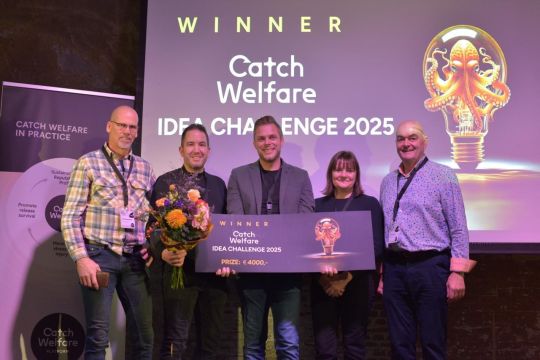
Crustaceans took home all the awards!
The innovation award went to a machine that stuns and tails Nephrops onboard fishing vessels and the idea challenge award went to the Clawbinder Pro machine. This Clawbinder Pro machine gently heats a material which shrinks and wraps tightly around crab claws, therefore negating the need for nicking, reducing stress for the animal and improving meat quality. Industry approached Stefan only a matter of one year ago about the need for an alternative to nicking, and hence the team have worked so well to deliver a functional prototype in this time.
The Clawbinder Pro team visited the UK in May 2025 with the first prototype of the machine. A second iteration of a prototype has now been made, and along with M&S, SAGB are looking to host a more detailed trial of this prototype on board a range of sizes of UK vessels as well as at a processing facility. The purpose of this trial is to evaluate the ease of use of this restraint method and the durability of the wraps.

We were invited to an additional day focusing on crustaceans, due to the extent of scientific development and legislative discussions occurring in recent years. The day began with presentations on new research. This was followed by a workshop to identify key welfare risks within the crustacean supply chain and what is needed in order to address them in an achievable manner. Naturally since SAGB was involved in creating the industry-led codes of practice for crustacean welfare across the UK supply chain which were published last year, the workshop began with an explanation of what we had achieved so far and the lessons we’d learnt along the way. This was an incredibly productive day, and the group agreed to progress with this work together whilst also coordinating some engagement with external people such as campaign groups.
Key talks relating to shellfish included:
Sahra Skripsky – Field Trial Coordinator & Program Lead at CanFISH – Eliminating buoy lines from fisheries eliminates unnecessary suffering of accidental bycatch
On the east coast of Canada, solutions are being developed to reduce the entanglement of right whales in crustacean trap lines. ‘Ropeless fishing’ technology is being lent out to fishermen, where the buoy will remain attached to the trap on the seafloor until the fisherman sends an acoustic signal to the trap to release the buoy to the surface – this technology is currently unaffordable for fishermen, however the rental scheme has been a great success with 32 skippers catching >340,000 lbs of snow crab with the loaned gear.
Mengjie Yu – Postdoctoral Researcher at College of Fisheries, Ocean University of China – Improving catch welfare in Chinese crab pot fisheries: research progress and future perspectives
Regarding the swimming crab (Portunus trituberculatus) pot fishery, Mengjie has found that increased soak times improve the efficacy of escape gaps at reducing bycatch of undersized crabs and other species – a soak time of 7 days will enable 90% efficacy of the escape gaps. He has also quantified the capture rates of ghost pots in this fishery. Regarding the Asian paddle crab (Charybdis japonica) gillnet fishery, he found that a larger mesh size improved the capture rates of legal-sized crabs whilst also reducing the probability of catching undersized crabs, and subsequently recommended a 90mm minimum mesh size. Mengjie is currently working on a welfare and quality assessment of the entire crab supply chain in China.
Lynne Sneddon – Researcher at Gothenburg University – Welfare of decapod crustaceans: implications for their use
Lynne’s research on shore crabs (Carcinus maenas) involved stimulating soft tissues at the joints within the body of the crab using acetic acid (a noxious stimulus) and von Frey hairs (a mechanical stimulus) while nearby ganglion activity were recorded; this was to learn about the differences in electrophysiological responses depending on the type of stimulus and where it is applied. Research on Nephrops norvegicus monitored heart rate during different methods of killing, some with the addition of an electric shock or pain relief.
Rodrigo Lorenzo – Researcher at CSIC – Assessment of stunning of crustaceans by using EEG recordings
Rodrigo has been investigating the potential for lobsters to recover from varying durations of electric shock, using electroencephalogram readings as a measure of consciousness. A short shock lasting 1 second is enough to make a lobster insensible, however they will recover and right themselves within 5 – 10 minutes. A 5 second stun will take longer for the lobster to recover from (~20 minutes or more). Discussion was had as to why the interest is on increasing the duration of the stun rather than increasing the amperage – this is because increasing the amperage is problematic, potentially causing overheating, salinity change and even issues with power supply.
Bjørn Roth – Senior Scientist at Nofima – Stunning and slaughter of lobster and subsequent effects on quality
Nofima have been investigating a variety of methods to kill and process crab and lobster, including dry vs. saltwater stunning, 1 second vs. 10 second stun duration, and a taste comparison between frozen and high pressure processed lobster meat.